
Product · 17 October 2026 · 2 min read
One graph for sound and pictures: how Infinite keeps them in step
Infinite runs a pull-based audio graph and a GPU texture pipeline off one BPM transport, so audio can drive visuals and visuals can drive audio.
By Naman Soni
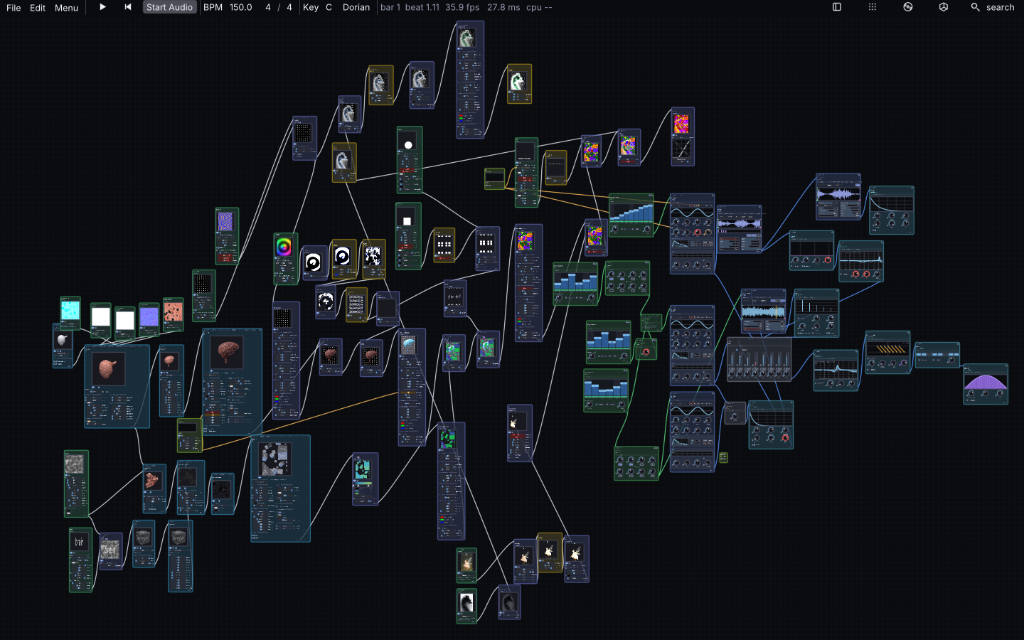
Video tools and audio tools usually live in separate programs. You wire them together with OSC, MIDI clock or a texture-sharing protocol, and you accept a little latency and jitter on the way. Infinite takes a different route: audio and visuals are two parts of one engine that share a transport.
Two graphs, one clock
The engine has two sides, and each one follows the rules of its own medium.
- Audio is a pull-based, sample-accurate graph. If a buffer is late, you hear a click, so it is built around a deadline.
- Visuals are a GPU texture pipeline on GLSL and OpenGL 3.2 Core. A dropped frame is far less noticeable, but throughput matters.
Both sides are tied to a global BPM transport, so a beat means the same moment in the sound and in the picture.
Modulation crosses the boundary
The useful part is what happens between the two. Any signal can modulate any control:
- an Audio Analyze node gives an 8-band FFT and onset detection;
- an LFO, Envelope Follower, Random or Pattern CV gives a moving number;
- an Image Analyze node reads luminance or motion from a picture.
Wire the output of one of those to a control and it moves. That control can be a shader parameter, a 3D transform, a synth knob or the slider of a hosted plugin. Sound drives pictures, and pictures drive sound.
Why one canvas helps
When both live on the same canvas, the connection is a cable you can see. There is no second application to launch, no port to configure and no project that has to be kept in sync by hand. A patch is also a plain-text .inf file, so it can be versioned, diffed and rendered without a window.
Try it
Open the Moves with the music template from the Library. It is a shape that grows with the sound, and it is the smallest example of the idea above.
Infinite is free and open source for macOS, Windows and Linux.