
design visuals
A DAW for you
Design visuals, make music and write code on one infinite canvas.
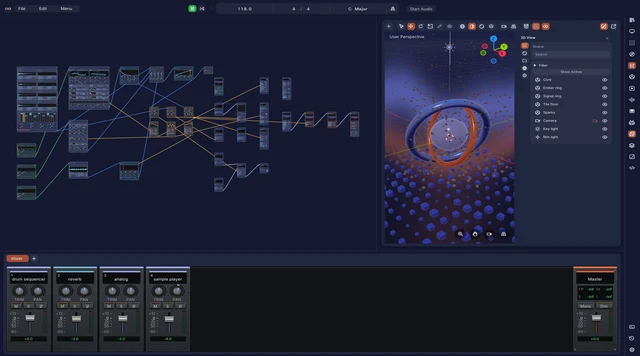
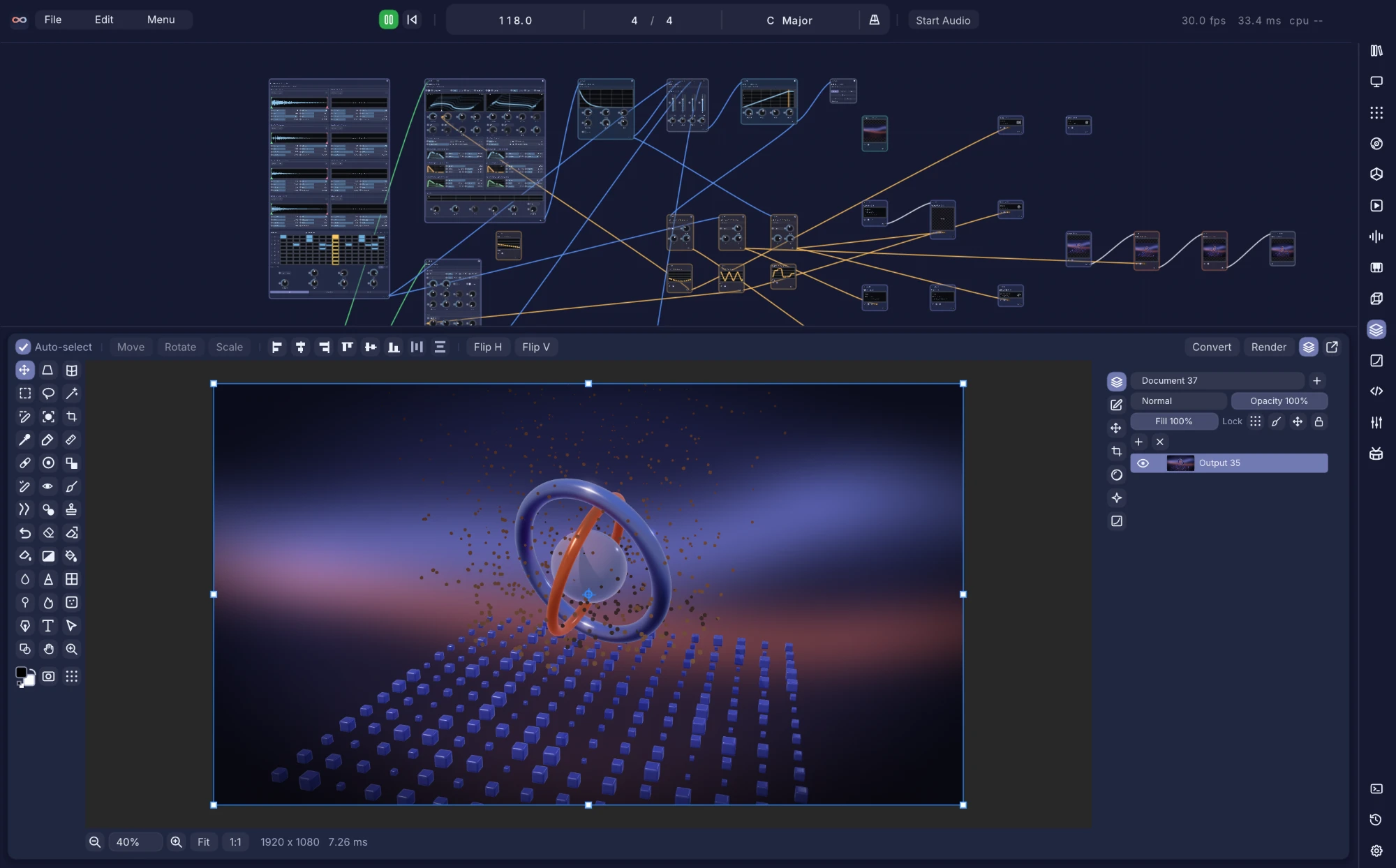
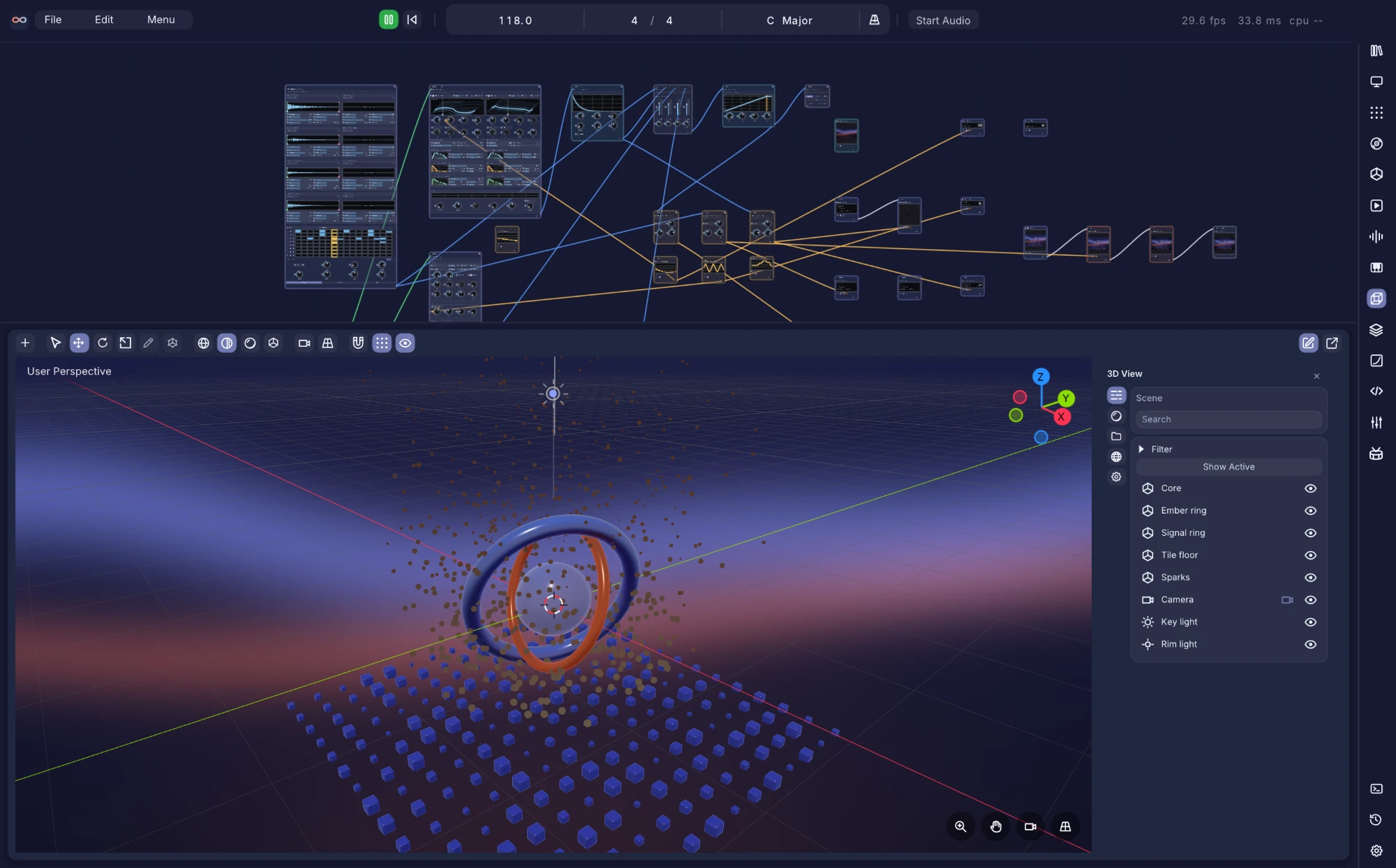


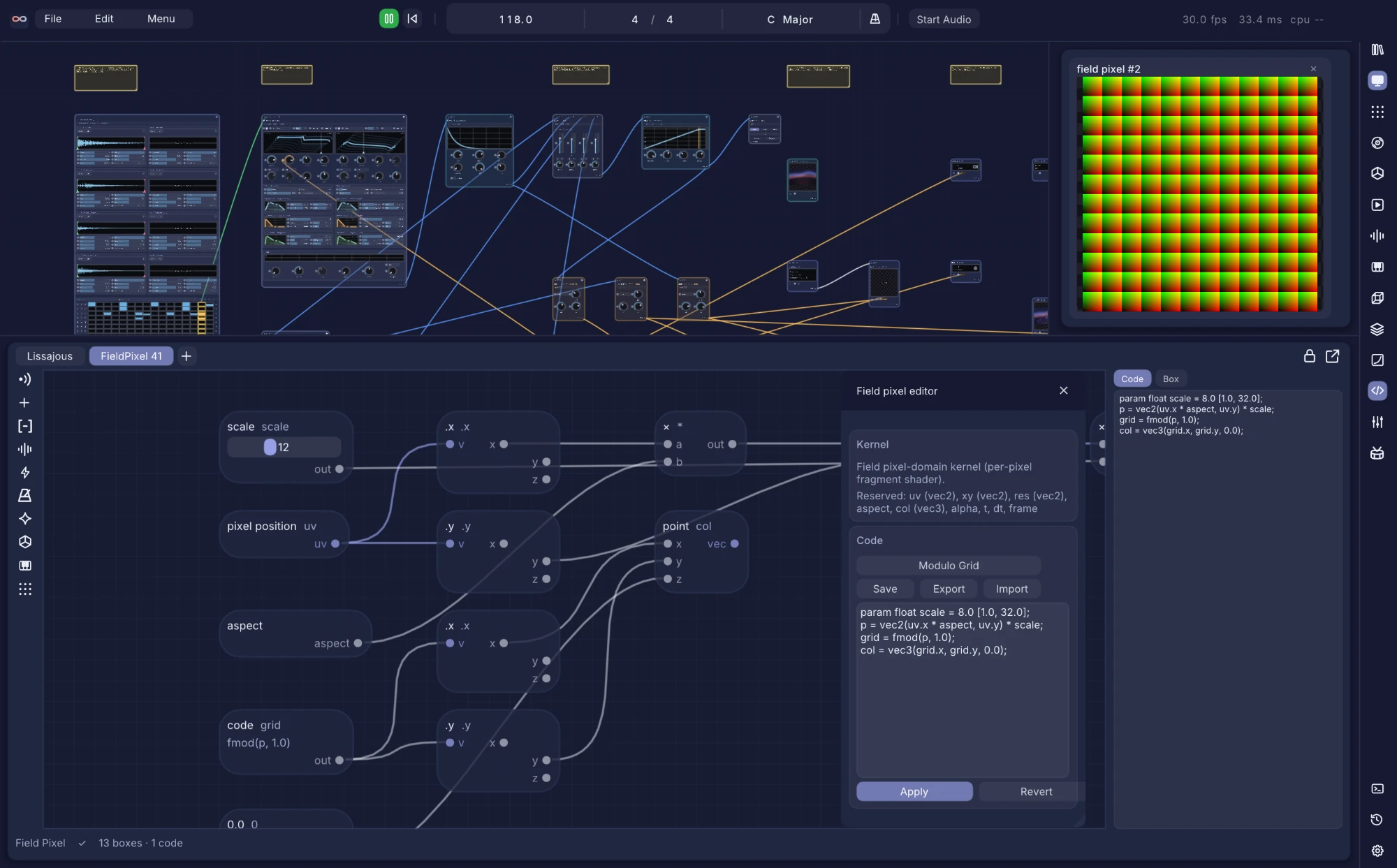


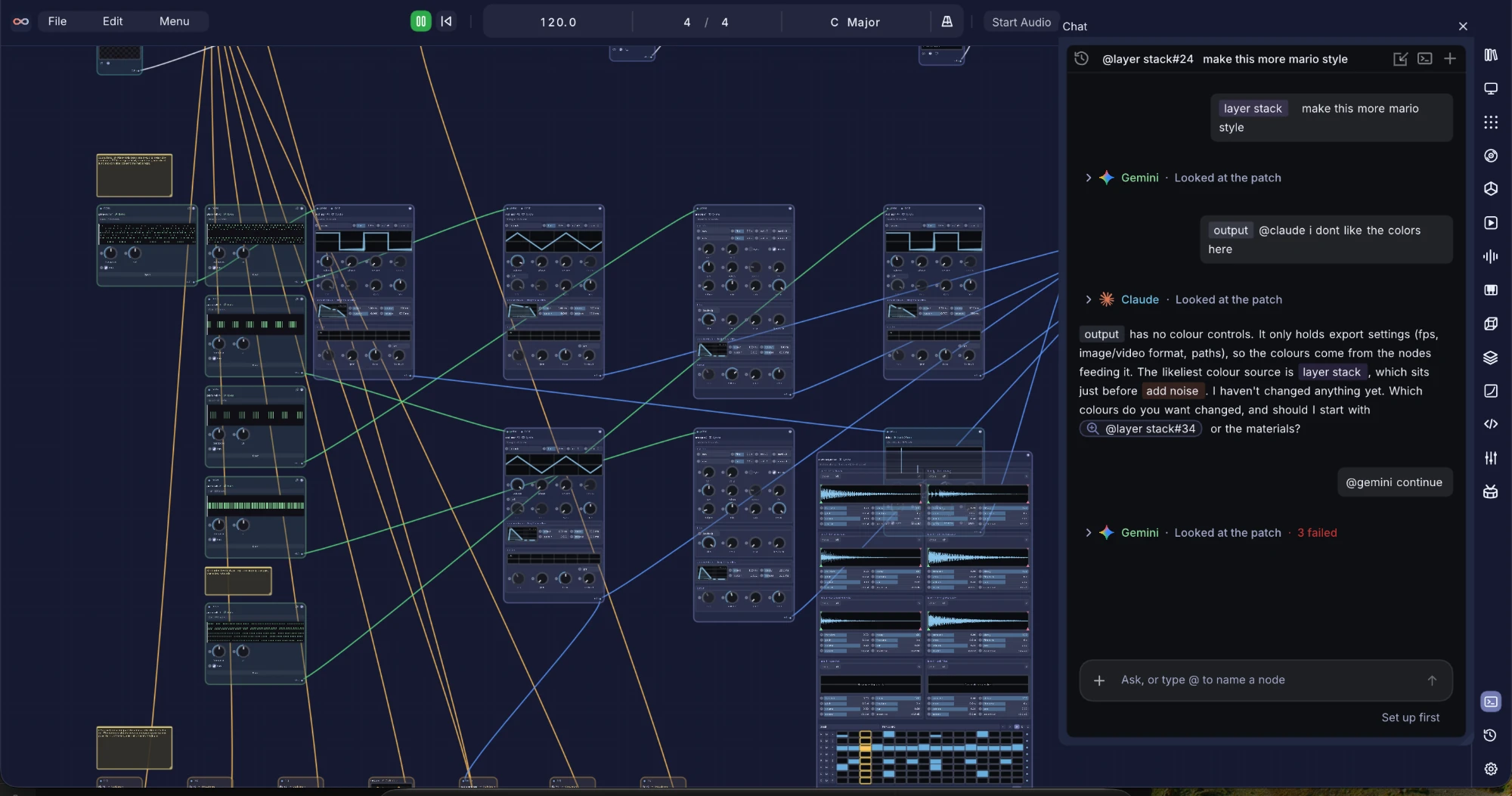
built like aninstrument
what if your DAWcould
make music
shape 3D
move anything
all at once.
It predicts your next move.
x[t+1] = phi * x[t] + theta + e
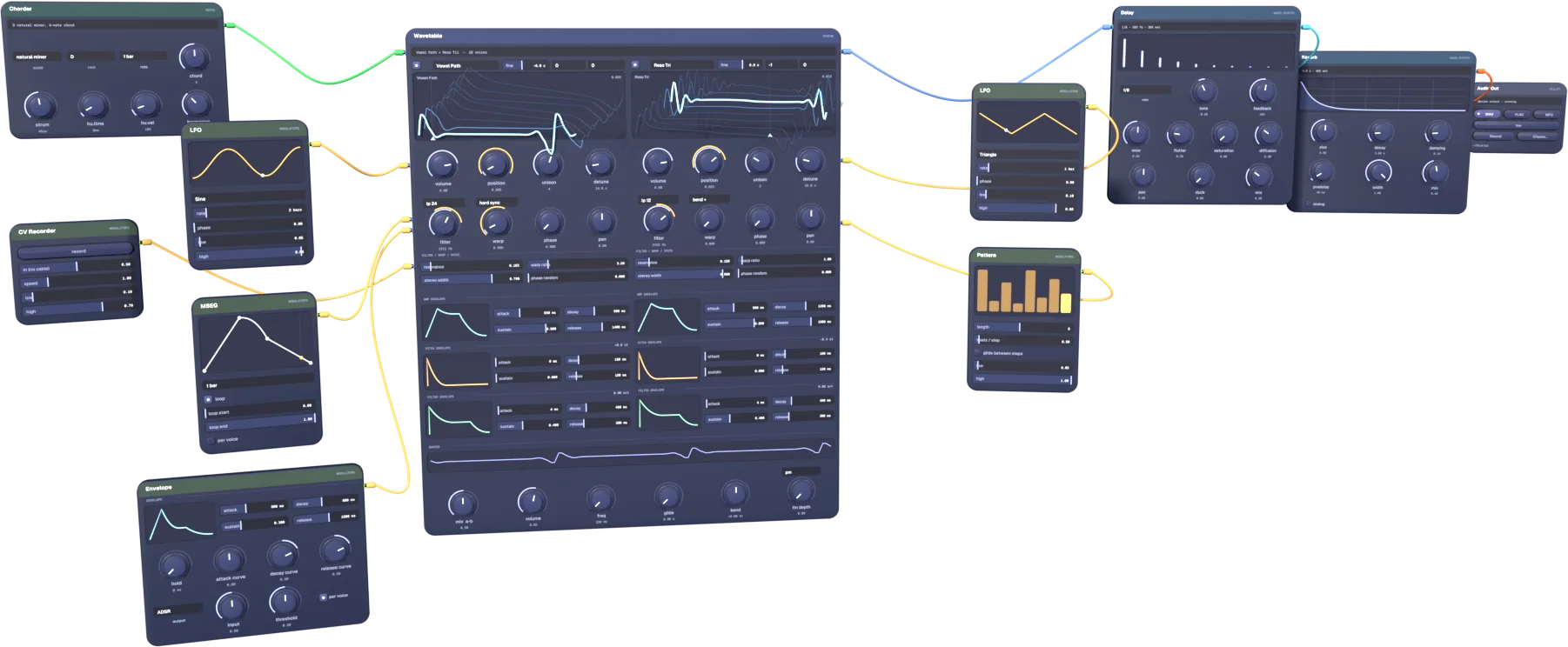
connected bynature
made in Infinite
first launch
Infinite is free and unsigned, so your OS asks once. Here is the one-time step for each.
Infinite is an ad-hoc signed community app, so macOS Gatekeeper asks for a one-time confirmation on first launch.
-
1
Double-click the app
Drag
Infinite.appto Applications and double-click it. macOS says it is from an unverified developer. -
2
Open anyway
Open System Settings, Privacy & Security, scroll to Security, and click Open Anyway.
-
3
Or one line in Terminal
Remove the quarantine flag instantly:
xattr -dr com.apple.quarantine /Applications/Infinite.app -
4
Or use Homebrew
Install from the terminal. The first-launch confirmation above still applies.
brew install --cask n1m21n/tap/infinite
The Windows build is a portable folder: no installer, nothing written to your registry. It is unsigned, so Windows warns once on first launch. Most PCs need the Intel / AMD (x64) build. On a Snapdragon X or other ARM laptop take the ARM64 build (preview) instead, best-effort: it compiles in CI but is not run by the automated tests (check Settings, System, About, System type if unsure).
-
1
Unblock the ZIP
Right-click the ZIP, choose Properties, tick Unblock, then OK. Then extract it. Doing this first saves you a prompt for every file inside.
-
2
Run anyway
Run
Infinite.exe. If SmartScreen appears, click More info, then Run anyway. Keep the folder together:Infinite.exeloads its assets from beside itself. -
3
Opening patches
Patches save as
.infinitefiles. Right-click one, Open with, Choose another app, pickInfinite.exeand tick Always. Dragging a patch onto the canvas works with no setup.
Infinite ships as one portable AppImage. It bundles the static AppImage runtime, so you do
not need libfuse2. Needs x86_64, glibc 2.35 or newer (Ubuntu 22.04+, Debian 12+,
Fedora 38+ or similar) and OpenGL 3.2 via X11 or XWayland.
-
1
Make it executable
Download
Infinite-x86_64.AppImage, then:chmod +x Infinite-x86_64.AppImage -
2
Run it
Double-click it, or run it from a terminal. Inside a container, or with no
/dev/fuse, extract and run instead:./Infinite-x86_64.AppImage --appimage-extract-and-run
Make something infinite
Infinite runs on macOS, Windows & Linux.
Email download link to my computerv2.1.0 release notes · free & open source · macOS 11+, Windows 10+, Linux
Made by one person
Donate
frequently askedquestions
What is Infinite?
Infinite is a free, open-source modular digital audio workstation (DAW) and real-time audiovisual environment. It lets musicians, creative coders and visual artists generate sound, host 64-bit VST3 and AU plugins, write real-time GLSL shaders and render 3D geometry on a single unified canvas.
Is Infinite completely free and open source?
Yes. Infinite is fully open source under the MIT licence for source code and GPLv3 for pre-built binaries that bundle VST3 hosting. There are no subscriptions, account registrations, telemetry paywalls or feature locks.
Can I use Infinite inside other DAWs like Ableton Live, Logic Pro, or FL Studio?
Yes. Infinite is available as a paid VST3 and AU plugin for external DAWs (Ableton Live, Logic Pro, FL Studio, Reaper, Bitwig Studio, Cubase). It brings Infinite's modular canvas, synthesizers, custom DSP kernels, and real-time graphics directly into your host track as an instrument or effect. It is a one-time perpetual purchase of $149 ($99 launch price), valid on two computers offline with zero subscriptions. See the plugin page or buy page for details.
Can I host my existing VST3 and AU plugins inside Infinite?
Yes. Infinite includes a native 64-bit VST3 and AU plugin host with full parameter modulation and sidechain routing. You can route audio through your favourite synthesizers and effect plugins or use visual nodes to modulate plugin parameters in real time.
How does Infinite generate visuals alongside audio?
Visuals and audio run synchronously on the same node graph. You can write real-time GLSL fragment shaders, render raymarched signed distance fields (SDFs) and animate 3D procedural meshes that react directly to live audio frequencies, FFT analysis or MIDI notes.
How does Infinite compare to Max/MSP, TouchDesigner, or Pure Data?
While tools like Max/MSP and TouchDesigner separate audio from visuals or require commercial licences, Infinite unifies modular audio DSP, VST3 hosting and GPU shaders into a single lightweight application without licence fees, launching in under a second.
Does Infinite support headless rendering and AI agent workflows?
Yes. Infinite includes a headless command-line interface, a Python SDK and an official Model Context Protocol (MCP) server. AI assistants such as Claude, Cursor and Windsurf can inspect, validate and render audio and video offline without opening the GUI. Every release carries a generated report of which node params render headless.