
Creative · 19 October 2026 · 2 min read
javascript sketches as nodes: draw with code, wire it to anything
how sketch nodes let you draw with javascript in infinite and expose real modulation pins to synths and audio signals.
By Naman Soni
on this page
creative coders generally face a difficult compromise:
- in the browser (p5.js, three.js, canvas2d): rapid iteration, clean drawing apis, but limited audio precision, browser sandbox limits, and no native vst3 or au plugin support.
- in native c++ (openframeworks, cinder): high performance, but long compilation cycles that break creative flow on every small aesthetic tweak.
with infinite, we bridged these worlds by embedding a high-performance javascript runtime directly into a native c++ modular daw.
1. the p5-style draw loop
inside any sketch node, you write clean, declarative javascript that hot-reloads on every keystroke without compiling or restarting:
// declare wireable parameters exposed on the node canvas
param("points", 8000, 1000, 20000);
param("drift", 0.15, 0, 1);
param("size", 1.5, 0.5, 4);

function draw(t) {
  background(0.04, 0.04, 0.07);
  const a = -1.4 + 0.25 * sin(t * drift);
  const b = 1.6 + 0.2 * cos(t * drift * 0.8);
  const c = 1.0 + 0.2 * sin(t * drift * 0.6);
  const d = 0.7;

  let x = 0.1, y = 0.1;
  const k = min(width, height) * 0.22;
  noStroke();

  for (let i = 0; i < points; i++) {
    const nx = sin(a * y) + c * cos(a * x);
    const ny = sin(b * x) + d * cos(b * y);
    x = nx; y = ny;
    if (i > 20) {
      fill(hsl(0.55 + 0.3 * (i / points), 0.7, 0.65, 0.4));
      circle(width / 2 + x * k, height / 2 + y * k, size);
    }
  }
}
2. wireable parameters: code meets modular graph
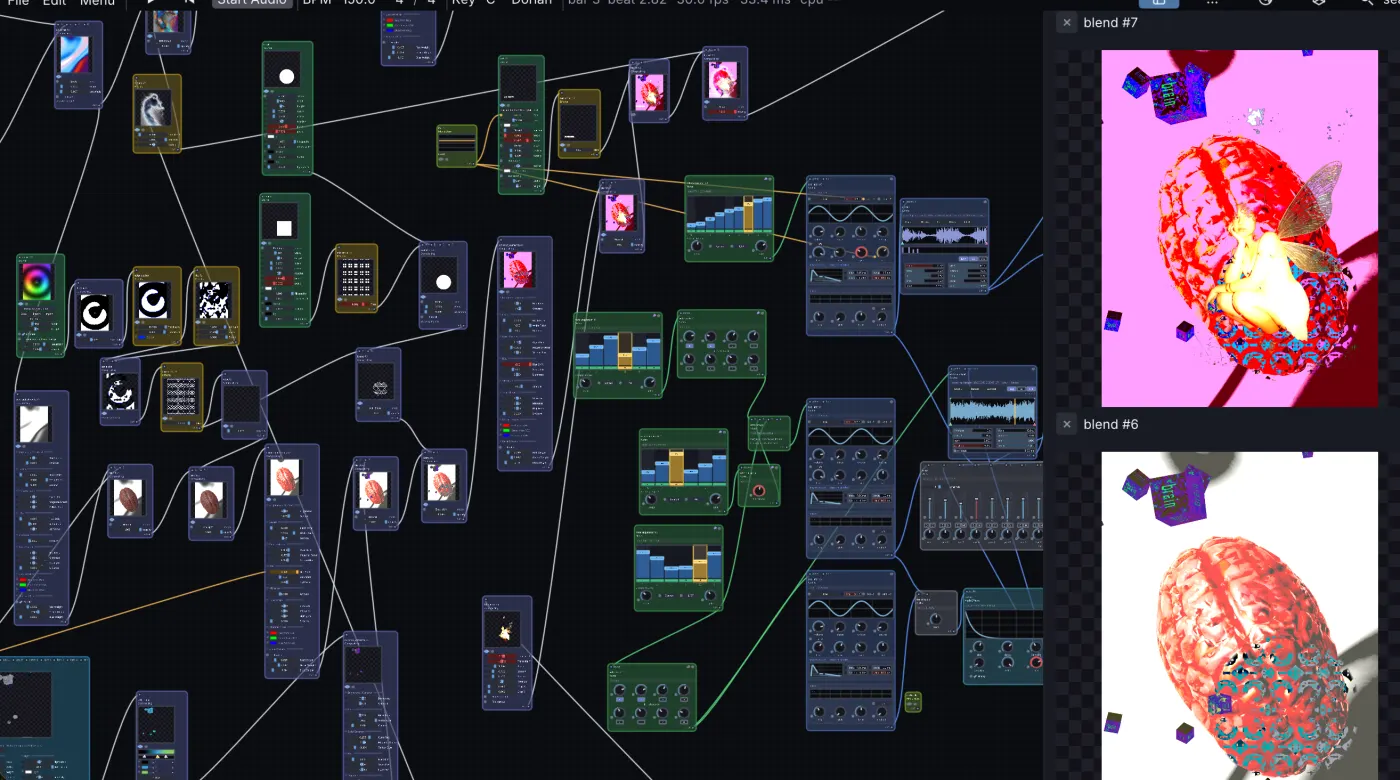
the param(...) calls dynamically create real, visual input pins on the node canvas. you can connect:
- a midi knob to modulate
drift. - an 8-band audio fft peak to pulse
size. - a low-frequency oscillator (lfo) to rotate the attractor phase.
3. native rendering performance
unlike web wrappers, the generated vector drawing commands stream directly into hardware-accelerated opengl framebuffers. you can render tens of thousands of points per frame with steady 60fps pacing while multi-track 48khz audio synths run in parallel.
- download infinite free (macos, windows, linux): infinitedevices.org
- source code on github: github.com/n1m21n/infinite