
Creative · 19 October 2026 · 5 min read
unique nodes in infinite: wave terrain, shape resonator, cymatics
explore infinite original nodes: convert images to sound with wave terrain, ring 3d geometry with shape resonator, and simulate chladni cymatics.
By Naman Soni
on this page
- 1. wave terrain: converting images and textures into sound
- 2. shape resonator: converting 3d geometry into physical sound
- 3. audio displacement: cymatics and mesh deformation
- 4. equation synth: desmos-style mathematical synthesis
- 5. audio ribbon: 3d physical waveform extrusion
- 6. audio color ramp: sound-driven color palettes
- 7. audio texture: audio-rate gpu textures
- more standout nodes to explore
most creative software falls into one of two camps: digital audio workstations that treat visuals as an afterthought, or visual patchers (like touchdesigner or blender) that treat audio as a simple control voltage or fft spectrum.
infinite was designed from day one on a unified execution graph. sound, 2d textures, and 3d geometry live in the same memory space, enabling node architectures that simply do not exist in conventional daws.
here is an in-depth breakdown of seven standout original nodes in infinite that bridge sound, mathematics, and geometry.
1. wave terrain: converting images and textures into sound
wave terrain synthesis treats any 2d image—whether a drawn sketch, a webcam feed, a reaction-diffusion pattern, or procedural noise—as a continuous 3d topographic terrain surface z = T(u, v).

how it works
- orbital trajectories: an audio-rate oscillator traces a closed parametric path
(u(t), v(t))across the image (such as an ellipse, lissajous curve, lemniscate, or spiral). - topographic sampling: as the orbital point scans across pixels, the surface height
zbecomes the instantaneous audio amplitude. - 10-level fourier mip pyramid: raw pixel sampling produces harsh digital aliasing. infinite solves this by computing a real discrete fourier transform (rdft) mip pyramid across 10 octaves, ensuring completely alias-free polyphonic synthesis across all 8 octaves.
2. shape resonator: converting 3d geometry into physical sound
what does a 3d torus sound like when struck? what does an icosphere sound like compared to a long cylindrical tube?
the shape resonator node answers this by computing the acoustic standing waves and vibration modes of any input 3d geometry mesh.

how it works
- laplace-beltrami modal solver: on a dedicated worker thread, infinite solves the surface-laplacian eigenvalues
λ_iof the mesh. - dispersion law: mode frequencies follow the dispersion of a physical membrane or thin plate:
f_i = tune × √(λ_i / λ_0)
- strike and pickup positioning: where you hit the 3d shape in space weights which modes resonate, while the pickup position determines which harmonics reach your speakers. hitting a nodal line silences that harmonic, exactly like a physical acoustic gong or vibraphone bar.
- lock-free triple buffer: the modal solve runs asynchronously, handing finished two-pole coupled-form phasor coefficients to the 48khz audio thread with zero glitches.
3. audio displacement: cymatics and mesh deformation
the audio displacement node takes any 3d mesh and deforms its vertex topology in real time directly from incoming audio waveforms.

five real-time modes
- normal waveform: pushes vertices outward along their surface normals proportionally to the raw oscilloscope audio signal.
- spectral bands: deforms vertices along the u/x axis based on real-time fft frequency bins.
- acoustic ripples: generates concentric radial wave rings expanding outward from the center.
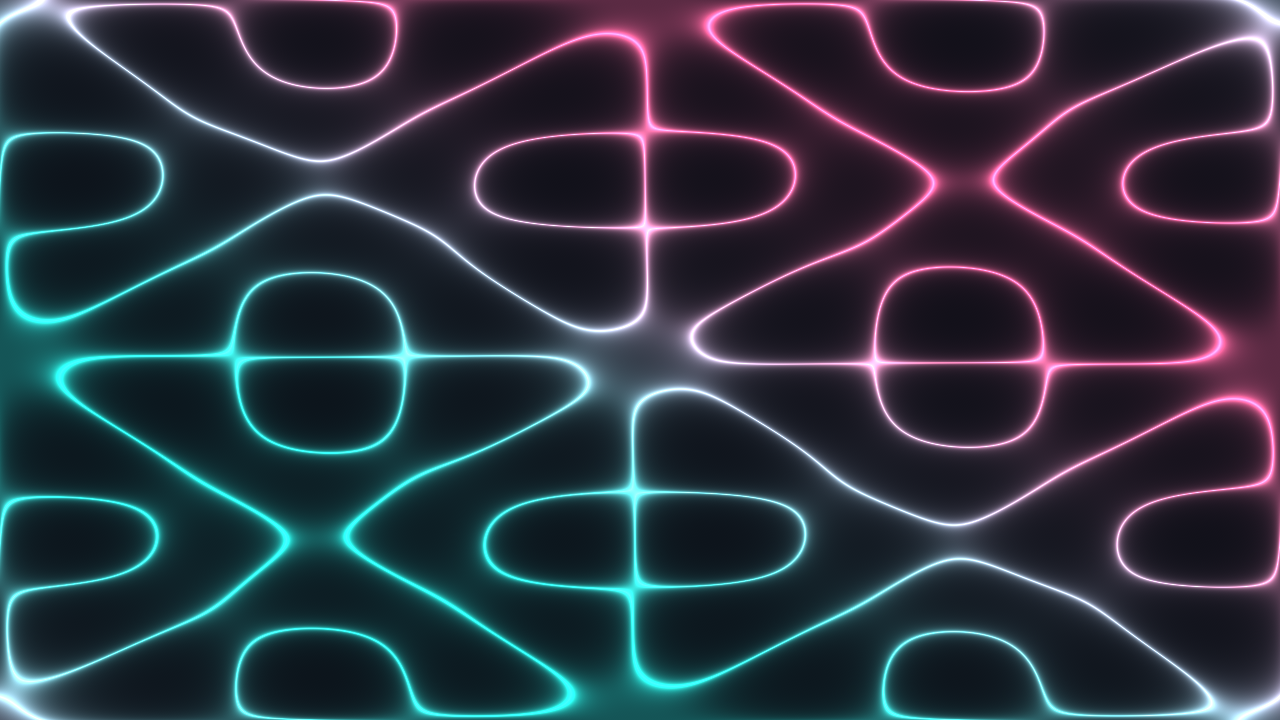
- chladni cymatics: simulates ernst chladni's 2d and 3d acoustic standing wave nodal patterns:
w = sin(n π x) · sin(m π y) ± sin(m π x) · sin(n π y)
- directional axis: displaces vertices along specific global or local cartesian axes.
4. equation synth: desmos-style mathematical synthesis
for artists who think in mathematical formulas, equation synth provides an interactive cartesian graphing plane where any mathematical formula y = f(x, a, b, c, d) becomes an anti-aliased polyphonic synthesizer.

whether exploring chebyshev polynomials, weierstrass fractal curves, or phase-modulated gaussian wave packets, equation synth graphs the function visually and compiles it into bandlimited wavetable mipmaps for pristine audio playback.
5. audio ribbon: 3d physical waveform extrusion
the audio ribbon node extrudes incoming audio waveforms into a physical 3d ribbon geometry traveling through space.

unlike 2d flat oscilloscope lines, the audio ribbon is a true procedural polygonal mesh that can be lit with directional lights, cast shadows, and rendered with physically based metallic and emission materials.
6. audio color ramp: sound-driven color palettes
the audio color ramp node analyzes live frequency spectrums and dynamically drives gradient color ramps used across 2d visuals, 3d materials, and shader backgrounds.

operating modes
- intensity mode: low frequencies cause deep color glow while high-frequency percussion triggers bright highlights.
- expansion mode: frequency band energies dynamically expand and contract the spatial boundaries of each color stop.
- spectrum mode: maps the continuous real-time fft spectrum directly onto the custom palette.
7. audio texture: audio-rate gpu textures
the audio texture node converts audio streams directly into a 2d gpu texture at 60 fps.

this texture can be cabled directly into materials, raymarchers, and field pixel shader nodes, allowing custom glsl kernels to sample audio buffers as standard sampler2D textures with zero cpu overhead.
more standout nodes to explore
in addition to these seven audiovisual transformers, infinite includes over 300 modular nodes spanning physics, generative art, and signal processing:
- reaction diffusion: gray-scott chemical morphogenesis simulation creating organic spots, stripes, and cellular patterns.
- klein bottle & mobius strip: non-orientable 4d and 3d topological manifold surfaces.
- fluid: real-time 2d navier-stokes grid fluid dynamics with velocity advection and dye injection.
- cloth: verlet particle-spring physics simulation responding to audio wind and turbulence.
- paulstretch: extreme 64-bit spectral phase vocoder stretching audio by 10x to 1000x into lush ambient drones.
- face, hand, & pose track: on-device neural vision modulators turning physical movement into modulation cables.
all of these nodes run natively on macos, windows, and linux, and can be inspected in the node reference manual and library gallery.