
Product
Procedural game audio and SFX synthesis in a headless node graph
How game developers synthesise procedural SFX, physical-modelling foley, and deterministic WAV variations in Infinite using Field kernels, Python, and CLI.
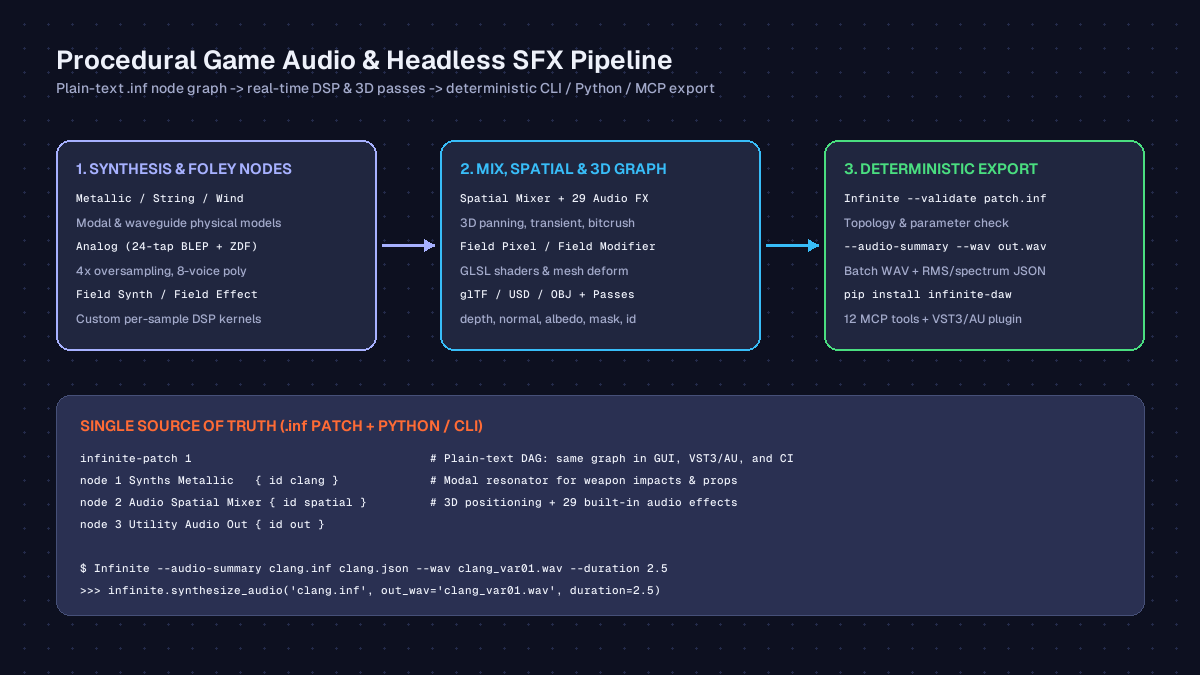
on this page
Game audio teams often face a familiar bottleneck: static sample packs repeat noticeably after ten minutes of play, while baking dozens of variations by hand in a traditional DAW slows down iteration. In Infinite, every sound effect, ambient bed, and foley layer lives in a plain-text .inf node graph that runs identically in the desktop app, inside a DAW via VST3 or AU, or headlessly from a build script.
For game developers, this means procedural game audio can be authored visually on the canvas and then rendered deterministically in CI or Python pipelines without opening a window.

Physical modelling and aliasing-free synthesis for SFX
Instead of stretching a single recorded hit across twenty pitches, Infinite ships native DSP nodes suited to synthetic SFX and organic foley:
- Metallic, String, Wind, and Piano: modal resonators and digital waveguides for impacts, weapon clangs, plucked props, and resonant environments.
- Analog, FM, and Wavetable: virtual analog synthesis with 24-tap BLEP/BLAMP oscillators,
4xoversampling, and 4-lane SIMD zero-delay feedback filters, alongside a 12-table wavetable bank. - Granular, PaulStretch, and Slicer: real-time granulation, extreme spectral time-stretching for drones and ambience, and onset-detecting beat slicing.
- Spatial Mixer and 29 audio effects: 3D headphone panning with head tracking, plus dynamics, filters, bitcrush, transient shaping, frequency shifting, and reverb.
Because patches are deterministic .inf text files, tweaking a seed, resonator damping, or filter cutoff produces reproducible variations rather than unrepeatable live recordings. For quick browser prototyping, the free SFX & ambient soundscape maker generates laser, coin, jump, explosion, click, rain, cyber hum, and lo-fi pad presets and exports both .wav and .inf files.
Instant background ambient sound design (free with credit)
For teams that need ambient beds, pads, or generative piano underscore right away without writing a patch from scratch, two browser engines ship ready to use:
- Generative Piano and Ambient Engine (
/piano/): Nocturne runs a physical-modelling piano, ambient drone, and water audio engine (piano-engine.js,ambient-engine.js,water-audio.js) directly in the browser for endless generative soundscapes. - Sample Generator WASM model (
/samples/): the Sample Generator compiles the C++ DSP engine (infinite_gen_wasm) to WebAssembly, supports?embed=1, and generates unlimited ambient pads, textures, loops, and drums in any key and scale as.wav(normalised to-14 LUFSand-1 dBTP) and.inf.
Both tools can be used directly for background ambient sound design in personal and commercial games, free with attribution: "sample from Infinite by Naman Soni (n1m21n), infinitedevices.org".
Custom per-sample DSP with Field Synth and Field Effect
When built-in nodes are not specific enough for a mechanic, Field lets you write per-sample DSP kernels directly inside a node. The typed IR infers the domain backend from your code: Field Synth for polyphonic sample-rate instruments, Field Effect for per-sample audio processing, Field Notes for algorithmic note and Euclidean triggers, and Spectral Field for per-bin STFT phase vocoder transforms.
You can edit code directly or use Field Patcher (Shift+F), a visual box-and-wire editor synced two-way with Field source. For audio-visual feedback in trailers or UI mockups, the same graph can drive GLSL shaders (Field Pixel), per-vertex mesh deformation (Field Modifier), or 3D render passes (depth, normal, albedo, mask, id) from imported glTF, GLB, USD, OBJ, PLY, or STL assets, or you can prototype 3D logo loops in the browser 3D maker.
Deterministic headless batch rendering for game pipelines
Once a .inf patch sounds right, you can integrate it into an asset pipeline using the headless engine, the Python SDK, or the 12-tool MCP server (npx -y infinite-engine init):
# Validate patch topology before rendering
Infinite --validate impact_sfx.inf

# Render deterministic WAV audio and inspect RMS/spectrum JSON
Infinite --audio-summary impact_sfx.inf summary.json --wav impact_01.wav --duration 2.5
From Python (pip install infinite-daw, zero third-party dependencies), build scripts can synthesise variations directly:
import infinite

infinite.validate("impact_sfx.inf")
infinite.synthesize_audio("impact_sfx.inf", out_wav="impact_01.wav", duration=2.5)
For AI-assisted sound design in Claude Desktop, Cursor, or Windsurf, the MCP server exposes infinite_synthesize_field_synth, infinite_process_field_effect, infinite_synthesize_field_notes, and infinite_validate_patch so agents can iterate on kernels and verify audio output without manual GUI steps.
Honest limits to plan around
Infinite is a young, MIT-licensed open-source project, so it is worth noting its boundaries before adopting it in production:
- No AAX plugin format: Infinite Instrument and Infinite FX ship as 64-bit VST3 (macOS, Windows, Linux) and AU (macOS), not Pro Tools AAX.
- Headless hardware restriction:
--renderand--audio-summaryrefuse patches that use live microphone, camera, or hardware MIDI input nodes (exit code4); use generators or audio files for batch builds. - Linux headless GPU renders: frame and video renders on Linux require a virtual display such as
xvfb-run -a Infinite ....
To try the workflow, explore the Game Developers hub, browse starter patches in the Infinite library, or download Infinite for macOS, Windows, and Linux.