
Creative
SuperFlux transient slicing and beat chopping in real-time DSP
How Infinite's Slicer node uses SuperFlux onset detection, centred STFT framing, and position-domain confinement for tight real-time beat chopping.
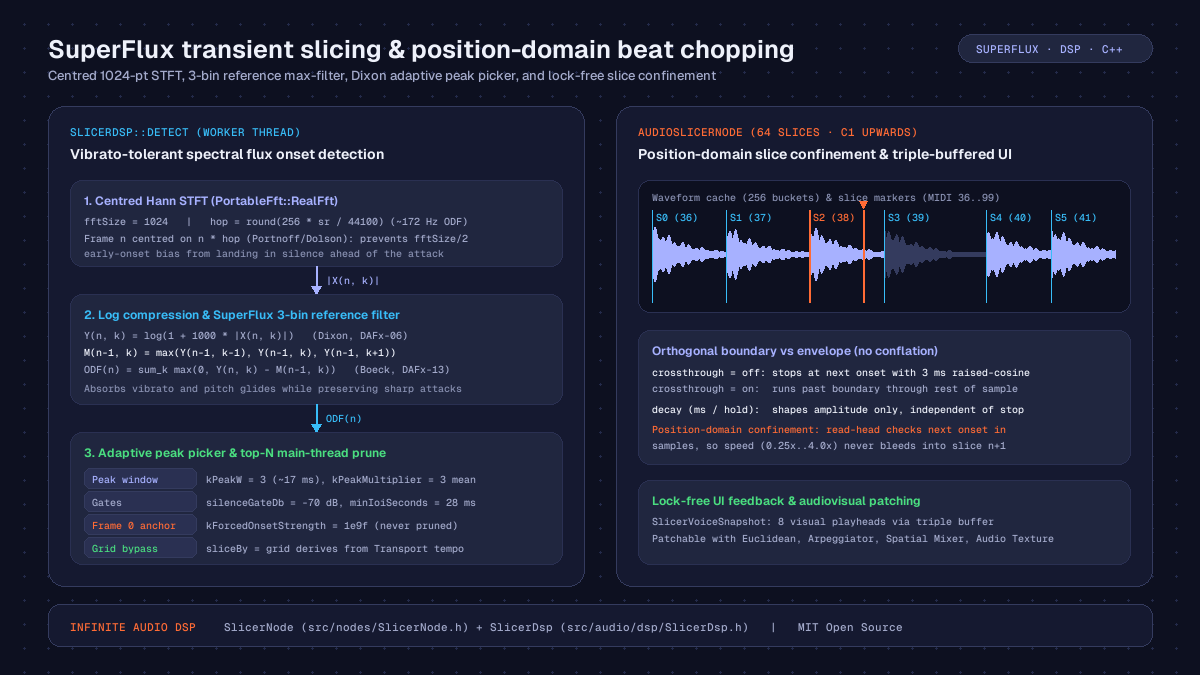
on this page
Open-source sample engines and transient tools are getting renewed attention across audio engineering. Recent releases such as Floe for CLAP, VST3, and AU sample libraries, Demucs stem separation compiled to Rust and WebAssembly for browser workflows, and transient-driven resynthesisers all point to the same practical demand: musicians want fast, inspectable ways to split a recording into playable rhythmic hits without wrestling with a wall of manual markers. Yet automatic transient slicing is deceptively fragile on real musical material, because vibrato, pitch glides, and un-centred FFT windows quietly ruin slice placement.
In Infinite, the Slicer node (SlicerNode) pairs a clean-room SuperFlux onset detector (SlicerDsp::Detect) with a lock-free, position-domain playback engine. You can drop in a drum break or melodic phrase, slice it by detected transients or by the global transport tempo grid, audition and drag individual markers on the waveform, and drive up to 64 slices chromatically from MIDI note 36 (C1) upwards alongside wind and piano physical models or visual nodes on the same canvas.

Why naive spectral flux misfires on vibrato and early frames
Basic onset detectors measure frame-to-frame increases in short-time Fourier transform (STFT) magnitude. That works on isolated dry snares, but breaks down on sustained basslines, strings, or vocals: when a pitch glides or vibrato shifts energy from one FFT bin to its neighbour, a naive differencer sees a sudden jump in the destination bin and fires a false-positive slice.
Infinite's SlicerDsp::Detect solves this by implementing two primary-reference techniques from the DAFx literature:
- Log-compressed spectral flux (Dixon, DAFx-06): Magnitude bins are compressed via $\log(1 + 1000 |X|)$ before half-wave-rectified differencing, keeping quieter percussive transients visible without letting broadband noise dominate the onset detection function (ODF).
- SuperFlux 3-bin reference maximum filter (Boeck & Widmer, DAFx-13): Before subtracting the previous frame from the current frame,
Slicerapplies a 3-bin maximum filter across the reference frame. Because vibrato shifts energy only by a bin or two, the widened reference absorbs the pitch wobble while genuine broadband attacks still stand out cleanly.
Equally important is centred STFT framing. Slicer uses a 1024-sample Hann window with a sample-rate-scaled hop (round(256 * sr / 44100)), keeping the ODF frame rate near 172 Hz across 44.1 kHz, 48 kHz, and 192 kHz files. Each frame n is centred on sample n * hop rather than starting there. An un-centred window reports an onset up to fftSize / 2 samples early, which lands the slice marker in the silence ahead of the attack where a -70 dB silence gate (silenceGateDb = -70.0f) would reject it outright.
Background worker analysis and instant repruning
Running an STFT and adaptive peak picker over a long recording does not belong on the audio thread. SlicerNode spawns a dedicated background worker with an abort flag so loading a new file or handing over hand-placed markers from the Sample Studio (SetSlices) cancels any obsolete scan cleanly.
Once the worker finishes, SlicerDsp::Detect returns strictly ascending onset frames gated by a 28 ms minimum inter-onset interval (minIoiSeconds = 0.028) and an asymmetric adaptive threshold (kPeakW = 3 frames, kPeakMultiplier = 3). Crucially, frame 0 is always stamped with a sentinel strength (kForcedOnsetStrength = 1e9f) so pruning down to the strongest N slices via the onsets parameter happens instantaneously on the main thread without re-running the FFT and without ever dropping the start of the sample.
Switching sliceBy to grid bypasses spectral analysis altogether and derives slice boundaries arithmetically from the global transport tempo and the selected division (kSlicerNumDivisions = 6). Hand-dragged markers in onsets mode are serialised into the patch (slices) so reopening or copying a node preserves manual edits without re-analysing the file.
Separating boundary confinement from amplitude decay
A common sampler bug is conflating where a slice stops with how fast its amplitude decays. SlicerNode keeps those two concerns strictly orthogonal:
crossthroughowns the boundary: When off (the default), each voice stops cleanly at the next slice's onset with a3 msraised-cosine fade so adjacent hits never bleed into one another. When on, playback runs past the boundary through the rest of the sample.decayowns the envelope: It shapes the amplitude falloff afterattack, with a hold detent at the top of its throw (kDecayInfinite) for full-level sustained playback.
Even more importantly, boundary confinement is evaluated in read-head position rather than wall-clock milliseconds. If you halve speed to 0.5 (clamped between 0.25 and 4.0, alongside pitch in -24..+24 semitones and finetune in -100..+100 cents), the voice takes twice as long in wall-clock time to reach the next onset and never reads past it.
Patching Slicer into generative audio and visual chains
Because AudioSlicerNode publishes up to 8 active playheads (kMaxVisualVoices = 8) into a lock-free triple buffer (SlicerVoiceSnapshot), the UI waveform draws live per-slice playheads alongside a 256-bucket cached envelope (WavePeaks) without touching the audio callback. You can sequence slices from Euclidean or Arpeggiator, modulate pitch, speed, or decay from an LFO, and route the audio out to Spatial Mixer and Audio Texture in one graph. Example patches and starter templates are available in the Infinite library.
There are clear limits to keep in mind. Infinite is a young, MIT-licensed open-source project: Slicer caps each instance at 64 slices (kMaxSlices = 64), and MIDI notes at or above 36 + sliceCount stay silent rather than wrapping back to slice 0. On desktop Infinite hosts VST3 and AU plugins, though AAX is not supported, and live hardware audio capture into Slicer's record in pin is refused in headless mode. For sound designers and DSP engineers who want transparent, sample-accurate beat chopping without opaque black-box behaviour, the full C++ implementation is ready to inspect, patch, and render.