
Product
Aliasing-free virtual analog DSP: BLEP, 4x oversampling, and ZDF
How Infinite's Analog synth combines 24-tap BLEP/BLAMP oscillators, 4x half-band oversampling, ADAA drive, and 4-lane SIMD ZDF filters below -80 dB aliasing.
on this page
Open-source audio engines and header-only C++20 synthesis libraries are drawing renewed focus to virtual analog DSP. Projects such as DSPark and modular DAW proposals like suhina-daw highlight a recurring engineering trade-off: building oscillators, saturators, and resonant filters from clean mathematical blocks is straightforward at low frequencies, yet high MIDI notes and driven filters expose harsh non-harmonic foldover that ruins mix clarity.
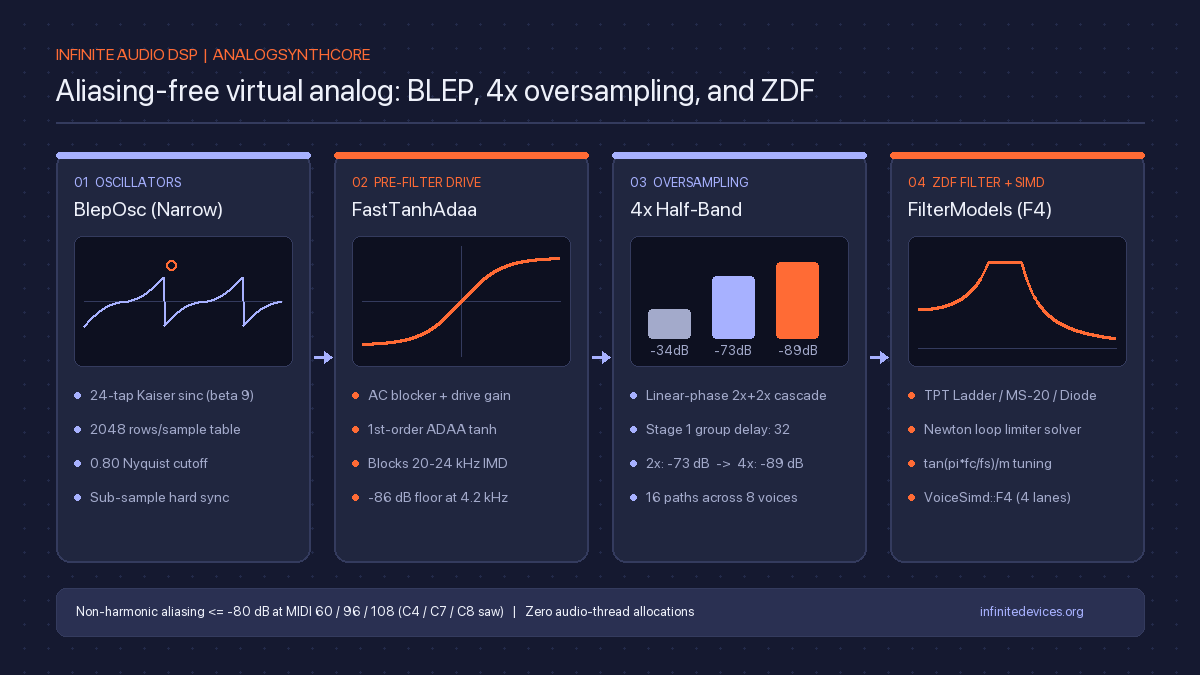
In Infinite, the Analog node (AnalogNode backed by AnalogSynthCore) solves that chain end to end on the audio thread. Rather than relying on a single anti-aliasing trick, it pairs narrow-band 24-tap windowed-sinc BLEP/BLAMP oscillators (BlepOsc), a 4x linear-phase half-band oversampler (Oversampler), antiderivative-antialiased (FastTanhAdaa) pre-filter drive, and 4-lane SIMD zero-delay feedback (ZDF) filters (FilterModels), keeping non-harmonic aliasing below -80 dB across C4, C7, and C8 saw waves.

Why 2-point PolyBLEP and 2x oversampling still alias
A 2-point polynomial BLEP (PolyBlepOsc) is cheap, yet on a 1.75 kHz sawtooth wave it still leaves -34 dB of aliasing, and a naive triangle wave aliases on every slope reversal. Even when an oscillator is replaced with a longer sinc table, two subtler traps remain:
- Table resolution vs kernel length: In
BlepOsc, each discontinuity correction is stored in a24-tap (kKernelHalf = 12) Kaiser-windowed (beta = 9.0) sinc residual table for both steps (BLEP) and slope kinks (BLAMP). Crucially, the table useskTableRes = 2048rows per sample of fractional position. At128rows per sample, linear-interpolation error alone left a-67 dBline at every folded harmonic (-30 dBtotal on a1.75 kHzsaw). - 20 to 24 kHz intermodulation before drive:
BlepOscoffers two cutoffs:kBandWide(0.90of Nyquist, flat to roughly18 kHzat48 kHz) for direct output likeWavetable, andkBandNarrow(0.80of Nyquist,-0.4 dBat16 kHz,-2.7 dBat18 kHz, and-52 dBat24 kHz) forAnalog. Because20-24 kHzenergy from a wide kernel intermodulates inside thetanhdrive and filter stages, no post-oscillator oversampling can remove the resulting foldover. Switching tokBandNarrowplus4xoversampling droppedAnalog's non-harmonic floor at4.2 kHzfrom-64 dBto-86 dB.
Hard sync in BlepOsc is also solved at the exact sub-sample instant the master oscillator wraps: the slave is stepped to the master's wrap point, reset, and stepped for the remainder of the sample with the jump band-limited, rather than snapping slave phase to 0 on sample boundaries.
Antiderivative drive and 4x oversampling
Inside AnalogSynthCore, each voice's mixed oscillators (osc1 with up to kMaxUnison = 7 unison voices, osc2, sub, and noise) pass through an AC blocker before entering a 4x linear-phase half-band cascade (kFilterOversample = 4, kFilterOversampleGroupDelay = 32 for the first stage).
Running the drive and filter at 2x is not enough: even with FastTanhAdaa (first-order antiderivative antialiasing on the tanh curve), the per-stage tanh nonlinearities inside the ladder filter still fold back to -73 dB non-harmonic on a clean 19 kHz input, whereas 4x drops that floor to -89 dB. Combined with kBandNarrow, a C4, C7, or C8 saw moves from -68 / -63 / -61 dB down below -80 dB. Using firstStageGroupDelay = 32 instead of the 64-sample effect default keeps CPU cost low enough for up to 16 oversampled filter paths across 8 polyphonic voices (kMaxVoices = 8).
Zero-delay feedback filters in 4-lane SIMD
Both Analog and Audio Filter share FilterModels.h, which implements three zero-delay feedback trapezoidal (TPT) prototypes alongside standard SVF modes:
- Moog 4-pole transistor ladder (
kModelLadder): Critical loop gainkCriticalK = 4.0fandkOscRatio = 1.0f. - MS-20 2-pole Sallen-Key (
kModelMs20): Positive feedback through a high-pass path,kCriticalK = 2.0f, keeping DC gain at1.0across resonance. - TB-303 4-pole diode ladder (
kModelDiode): Coupled stages withkCriticalK = 22.1049383fandkOscRatio = 0.726483157f. Because a raw diode ladder droops by-27 dBat full resonance,MakeupGainnormalises its passband level to match the transistor ladder.
Each OTA-style stage saturates on the difference it integrates and linearises tanh(v) ~= v * T(v') around the previous sample (Slope(v) = FastTanh(v) / v), turning the coupled stages into a linear system solved outright, while the loop's feedback limiter (fb = L * tanh(fb_in / L)) is solved via Newton's method (SolveLimiter). CutoffToG scales tan(pi * fc / fs) / m so every model self-oscillates on the exact cutoff pitch.
All FilterModels code is templated on float or VoiceSimd::F4, allowing AnalogSynthCore::DriveAndFilter4 to process four voices in lockstep per stereo side (kLaneGroups = kMaxVoices / 4 = 2) with identical floating-point operation ordering to the scalar path.
Patching Analog inside the node graph
On Infinite's canvas, Analog connects directly to note generators like Euclidean and Piano Roll, per-voice modulators, and downstream DSP or visual nodes such as Audio Effect, Spatial Mixer, and Audio Texture, or sits alongside physical models like Wind and Piano. Ready-to-run synth patches and starter templates are available in the Infinite library, or you can download Infinite to inspect the node graph directly.
There are clear limits to keep in mind. Infinite is a young, MIT-licensed open-source project: Analog caps polyphony at 8 voices (kMaxVoices = 8) and unison at 7 (kMaxUnison = 7), desktop plugin hosting supports VST3 and AU without AAX, and live hardware audio inputs are refused in headless mode. For DSP engineers and sound designers who want inspectable, zero-allocation virtual analog synthesis, the full C++ implementation is open to read, benchmark, and patch.