
Compositing node
Invert
Mirrors an input modulator around a low/high pivot, so rises become falls and vice versa — and it still behaves correctly on signals that run outside the usual 0..1 range.
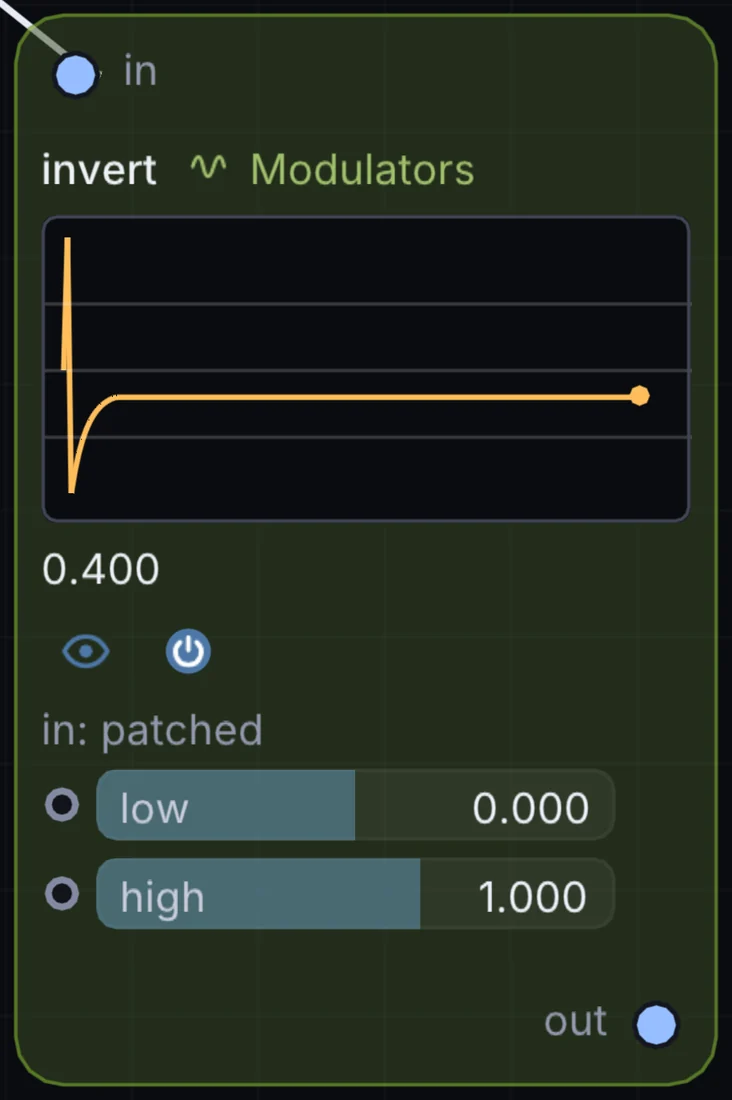
What it does
Invert is a compositing node: it layers, masks and routes pictures. It takes control signal in and gives control signal out.
Try it
Invert an LFO feeding one destination while the un-inverted LFO feeds another, so two parameters move oppositely together.
Inputs and outputs
Inputs
- control signal in
Outputs
- control signal out
Controls
Every control with a range can be driven by a modulator, a note, an audio level or a sketch.
| Control | Range or options | Default |
|---|---|---|
| in (no cable) | 0 to 1 | 0.5 |
| low | -4 to 4 | 0 |
| high | -4 to 4 | 1 |
Example patch
This patch wires Invert to what it needs and shows the result. Download it, then use File, Open in Infinite, or read it here: it is plain text.
infinite-patch 1
rev 2
# Invert: a starting patch for the Invert node
node 1 Modulators Invert
  id node
  pos 520 300
end
node 2 Modulators LFO
  id lfo0
  pos 0 300
end
node 3 Source Shape
  id shape
  pos 1080 300
end
node 4 Utility Output
  id out
  pos 1640 300
end
mod node constantIn lfo0 0 0 1 0.5
mod shape sizeX node 0 0 0.6 0.5
cable out 0 shape