
Creative
Real-time OpenGL 4.1 path tracing with BVH texture buffers and AgX
How Infinite's Render 3D node runs a progressive OpenGL 4.1 path tracer using RGBA32F BVH texture buffers, 12 ms strip budgets, and shared AgX tonemapping.
on this page
Real-time OpenGL 4.1 path tracing lets a modular 3D scene refine into physically based light transport without requiring compute shaders, hardware ray-tracing cores, or an external offline renderer. Recent graphics engineering threads on Hacker News and open-source rendering repositories, from pushing Three.js lighting pipelines toward studio quality to multi-target shader toolkits like LYGIA and TypeGPU and experimental audiovisual film adapters, highlight how much effort goes into closing the gap between fast interactive viewports and physically plausible shading.
In Infinite, the Render 3D node (Render3DNode) bridges both workflows inside a single patch graph. While you orbit a Camera, modulate a Light, or animate geometry, forward rasterisation keeps the viewport responsive. The moment the view holds still, Render3DPathTrace takes over and progressively accumulates Monte Carlo samples using GL_TEXTURE_BUFFER arrays and the same display colour pipeline as the raster pass.

Why OpenGL 4.1 still constrains portable engines
Cross-platform creative tools that target macOS alongside Windows and Linux hit a well-known graphics API ceiling: Apple froze desktop OpenGL at version 4.1 core, which omits compute shaders and Shader Storage Buffer Objects (SSBO). Many path-tracing tutorials assume Vulkan, OptiX, or OpenGL 4.3 compute kernels, leaving OpenGL 4.1 engines with either a separate Metal backend or raster-only approximations.
Render3DPathTrace sidesteps that split by running its entire ray-traversal and shading loop inside a standard OpenGL 4.1 / 3.3 core fragment shader. Every acceleration structure, triangle buffer, and material table lives in RGBA32F buffer textures (GL_TEXTURE_BUFFER bound to samplerBuffer uniforms) and is read via texelFetch. The same C++ and GLSL code path compiles and runs across macOS, Windows, and Linux without maintaining duplicate compute backends.
Flattening a two-level BVH into samplerBuffer textures
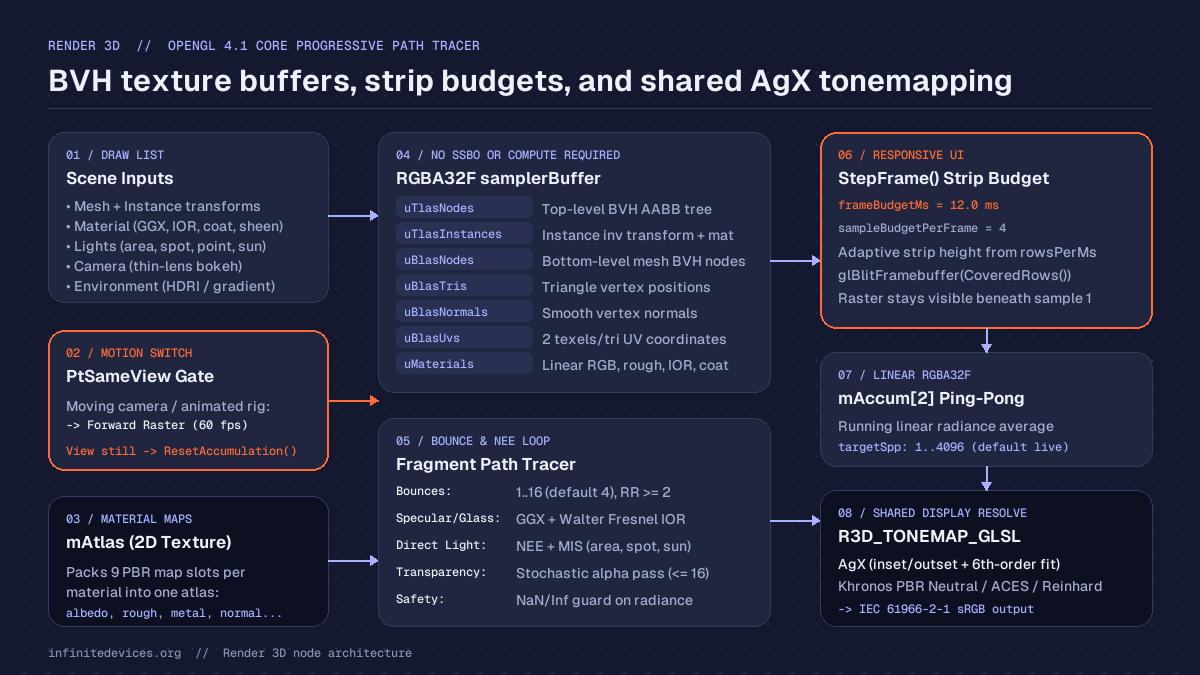
When geometry changes, Render3DPathTrace::UploadScene() builds bottom-level acceleration structures (Bvh::Blas) for each unique mesh and a top-level acceleration structure (Bvh::Tlas) over all placed instances, then packs the scene into seven RGBA32F buffer textures:
uTlasNodesanduTlasInstances: Store the top-level bounding-volume hierarchy and per-instance inverse transforms plus material IDs.uBlasNodes,uBlasTris,uBlasNormals, anduBlasUvs: Hold the per-mesh BVH tree, triangle vertex positions, smooth normals, and two texels per triangle for UV coordinates.uMaterials: Encodes linear-lightPtMaterialrecords covering base colour, metallic, roughness, emission, index of refraction (ior), dielectric specular level, transmission, clearcoat, sheen, opacity, and alpha cutoff.
To stay well within fragment-shader texture-unit limits, material maps are not bound as dozens of separate samplers. Instead, BuildAtlas() packs every active Material texture across up to nine map slots (albedo, roughness, metallic, normal, emission, clearcoat, sheen, transmission, and opacity) into a single 2D atlas (mAtlas), passing normalised UV rectangles inside uMaterials.
Keeping a 12 ms frame budget with adaptive strip tracing
A full-screen Monte Carlo sample on a complex mesh can easily exceed a 16.6 ms display interval on integrated GPUs or an 8 GB Apple Silicon laptop. Blocking the main thread would freeze node dragging, timeline playback, and audio-reactive modulation.
Render3DNode prevents stalls with two mechanisms in Render3DPathTraceCook.cpp and Render3DPathTrace::StepFrame():
- Motion gating (
PtSameGeometryandPtSameView): While the camera, lights, environment, rig, or animated geometry change,Render 3Dstays on forward rasterisation. OncePtSameViewconfirms the scene is still, accumulation resets and progressive tracing begins. - Adaptive horizontal strips:
StepFrame()targetsframeBudgetMs = 12.0fand caps live refinement atsampleBudgetPerFrame = 4. It traces horizontal strips ofmStripRowsheight, callsglFinish(), measuresrowsPerMs, and scales the next strip height torowsPerMs * frameBudgetMs * 0.8(clamped between8rows and full height). Until the first full sample completes,Render 3Dblits onlyCoveredRows()over the existing raster frame, so the viewport never flashes black.
Offline renders bypass the 12 ms cap via RenderToSpp(), tracing straight up to ptSamples (clamped between 1 and 4096) with maxBounces clamped between 1 and 16 (default 4).
Physically based shading, NEE, and thin-lens bokeh
Inside the fragment shader, each bounce evaluates the full PtMaterial surface model:
- Opaque and glass lobes: GGX microfacet specular and cosine-weighted hemisphere diffuse sit alongside Walter et al. dielectric transmission (
ior,transmission,transmissionRoughness) with exact Fresnel reflection/refraction and clearcoat support. - Next-Event Estimation (NEE) and MIS: At each hit, up to eight scene lights (directional, point, sun, ambient, spot, and rectangular area lights) are sampled directly, with Multiple Importance Sampling (
wMis) weighting area-light samples against BSDF direction sampling. - See-through alpha and Russian roulette: Alpha-blended or alpha-cutout surfaces pass through up to 16 layers without consuming a bounce, and Russian roulette terminates low-throughput paths from bounce 2 onward. Any
NaNorInfradiance sample is zeroed before hitting the ping-pongRGBA32Faccumulation buffers (mAccum[2]). - Real camera optics:
SetLens()convertsdofAperture,focusDistance,dofBlades,dofRotation, anddofRatiointo physical thin-lens sampling for polygonal bokeh, matching the focus plane of the raster depth-of-field pass.
You can wire procedural meshes from Infinite's 3D nodes such as L-System or Field Primitive directly into Render 3D, light them with an Environment HDRI or sky gradient, and drive any light or material parameter from audio analysis before exporting stills or video.
Shared AgX and Khronos PBR Neutral display resolve
Switching from raster motion to path-traced stillness breaks visual continuity if the two renderers use different tone curves. In Infinite, both the forward raster shaders and Render3DPathTrace::ResolveDisplay() include R3D_TONEMAP_GLSL (Render3DTonemap.h).
That header implements Troy Sobotka's AgX (agxTone, using inset/outset 3x3 matrices, log2 encoding over -12.47393 to +4.02607 stops, and a 6th-order polynomial contrast curve) alongside Khronos PBR Neutral (neutralTone), ACES, Reinhard, and None, followed by IEC 61966-2-1 sRGB transfer encoding. Saturated emissive lights and bright specular highlights roll off identically whether you are scrubbing a parameter live or letting a frame converge.
Honest limits of the current architecture
- Raster-only point clouds: GPU point clouds and particle sprites (
GetGpuPoints(),GetPointCloud()) are skipped byUploadScene()and remain raster-only. - Animated scenes stay raster: Because
PtSameViewresets accumulation whenever geometry, lights, or cameras move, fast audio-reactive animations render with the forward raster pipeline rather than accumulating multi-bounce path-traced frames per tick. - No hardware RT cores: OpenGL 4.1 fragment-shader BVH traversal is portable across macOS, Windows, and Linux, but high-polygon meshes trace more slowly than dedicated hardware ray-tracing pipelines.
If you want to inspect how Infinite keeps 3D graphics and audio synthesis decoupled across threads and processes, read our notes on out-of-process VST3 and AU plugin IPC, or explore the full architecture on the Infinite developers page.