
Source node
Shadertoy
Runs a shader pasted from shadertoy.com as it is: the mainImage code, Buffers A to D and the Common tab, all live. iChannel0 to iChannel3 are image inputs for feeding pictures in, and an unwired channel reads its buffer. Each 'uniform float name; // lo..hi' line in the shader becomes a knob you can modulate, so a shader's own controls work like any other dial. Also called a GLSL shader, a fragment shader or a shader toy: the way to bring generative code art into a patch.
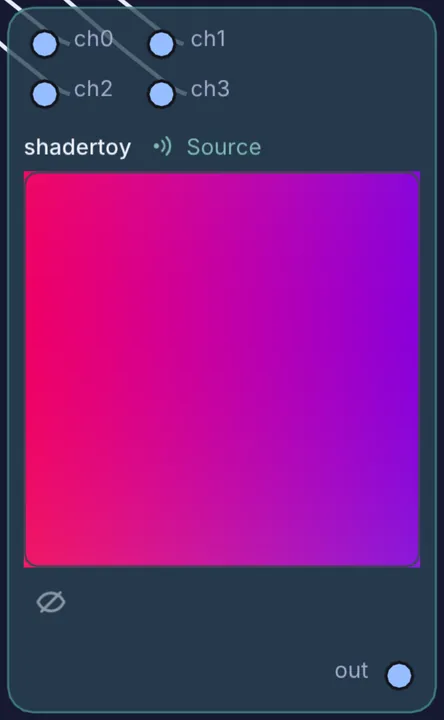
What it does
Shadertoy is a source node: it makes a picture from nothing, so it sits at the start of a visual chain. It takes picture in and gives picture out.
Try it
Paste a fractal shader and wire an LFO into one of its uniform knobs so it zooms on the beat.
Inputs and outputs
Inputs
- picture iChannel0
- picture iChannel1
- picture iChannel2
- picture iChannel3
Outputs
- picture out
Controls
Every control with a range can be driven by a modulator, a note, an audio level or a sketch.
| Control | Range or options | Default |
|---|---|---|
| width | 16 to 4096 | 1024 |
| height | 16 to 4096 | 1024 |
| animate | on or off | on |
| buffers | no buffers, buffer A, buffers A + B, buffers A - D | 0 |
Example patch
This patch wires Shadertoy to what it needs and shows the result. Download it, then use File, Open in Infinite, or read it here: it is plain text.
infinite-patch 1
rev 2
# Shadertoy: a starting patch for the Shadertoy node
node 1 Source Shadertoy
  id node
  pos 520 300
end
node 2 Source Ramp
  id in0
  pos 0 220
end
node 3 Source Ramp
  id in1
  pos 0 510
end
node 4 Source Ramp
  id in2
  pos 0 800
end
node 5 Source Ramp
  id in3
  pos 0 1090
end
node 6 Utility Output
  id out
  pos 1080 300
end
cable node 0 in0
cable node 1 in1
cable node 2 in2
cable node 3 in3
cable out 0 node